Programmatic SEO: scaling content the right way
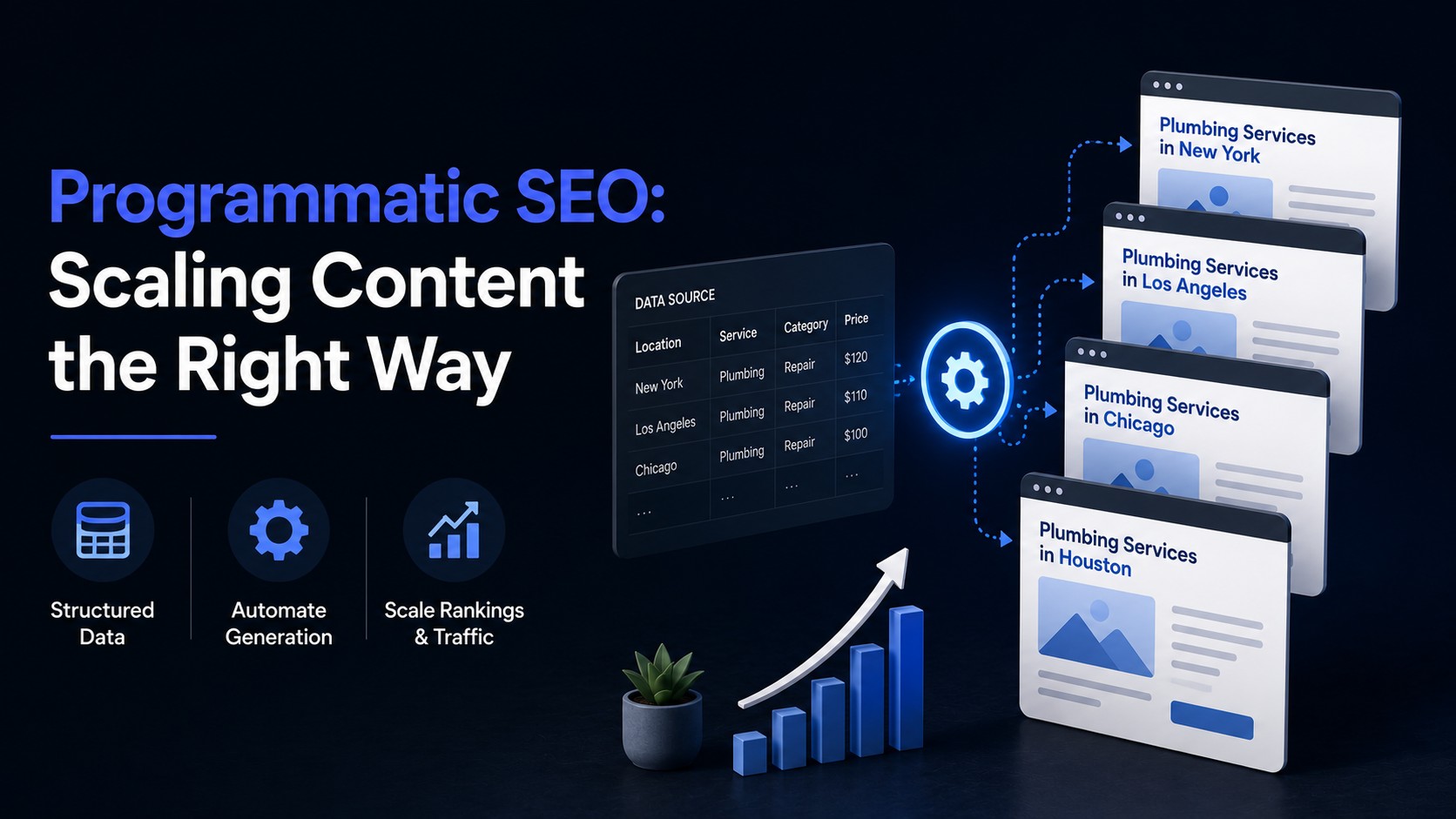
One template, a spreadsheet, and ten thousand pages live by Friday. That is the pitch for programmatic SEO, and it is real. It is also exactly how sites bury themselves under thin, near-identical pages that Google refuses to index. The method is powerful and easy to get wrong.
Programmatic SEO is the practice of generating many search-targeted pages from one template and a structured dataset, rather than writing each page by hand. It works when you have a repeatable page pattern that matches genuine search demand, such as 'flights from [city] to [city]' across thousands of routes.
When programmatic SEO fits
This approach suits a specific shape of problem: many queries that follow the same pattern, each backed by data you can structure. Think location pages, product comparisons, or matchups between two options. It fits ecommerce catalogues, directories, travel, and real estate naturally. It does not fit topics that need original thinking or a human point of view, where one strong hand-written article beats a thousand templated ones. If your content cannot be described as a pattern plus a dataset, this is not your tool.
Start with demand, not the template
The failure mode is building pages nobody searches for. Before you generate anything, validate that people actually search each variation. Do the keyword research to confirm demand across your variables, and group the terms by intent. A pattern like '[service] in [city]' only works where both the service and the city have real search volume. Generating a page for every possible combination, including the empty ones, is how you flood your site with pages that will never rank and drag down the ones that could.
Build a template worth ranking
A good programmatic page answers the query as well as a hand-made one would. The template is your unit of quality, so invest there. Each page needs genuinely useful, variable content, not just a swapped-out city name in otherwise identical text. Pull in unique data points, relevant details, and elements that differ meaningfully per page. If a visitor could not tell your page apart from a competitor's by anything except the keyword, Google will not see the value either.
Data quality decides everything
Your pages are only as good as the dataset behind them. Clean, accurate, detailed data produces useful pages; sparse or wrong data produces junk at scale, and errors multiply across every page at once. Spend the time to source and clean your data before generation. Adding structured data markup helps search engines parse these pages and can earn rich results, which matters more when you have thousands of similar listings competing for attention.
Avoid the thin-content trap
This is where most programmatic projects die. Google's systems are good at spotting mass-produced pages with little value, and it will simply leave them out of the index. If you find large batches sitting unindexed, our guide on fixing pages not indexed by Google explains the quality judgment at work. The same care applies whether a human or a model wrote the words. Templated pages still have to earn their place, so do not treat AI generation as a shortcut around quality.
Handle the technical side at scale
Thousands of pages create thousands of technical questions. Your internal linking has to help Google discover and understand the hierarchy, so build hub pages and sensible categories rather than a flat sea of URLs. Keep your sitemaps current, watch your crawl budget, and make sure the template renders fast, because performance problems multiply across every generated page. Sites operating at this size share a lot with enterprise SEO, where scale itself is the challenge.
Give each page a reason to exist
The strongest programmatic pages add something a competitor's version lacks. On a location page, that might be local pricing, real listings, or genuinely area-specific detail rather than a city name pasted into boilerplate. On a comparison page, it might be a clear recommendation instead of a neutral table anyone could generate. Ask what a searcher gains from your page that they could not get from the ten others targeting the same query. If you cannot answer that, the page is filler, and filler at scale is a liability rather than an asset.
Measure, then prune ruthlessly
Launching the pages is the start, not the finish. Track which ones earn impressions and clicks, and be willing to cut the dead weight. Pages that get no traffic after a fair window are not neutral; a big mass of low-value pages can weigh on how Google sees your whole site. Noindex or remove them. Measure the winners' contribution to your SEO ROI, double down on the patterns that work, and drop the ones that do not. Our free SEO tools help you spot which templated pages are pulling their weight, and a free audit flags thin pages before they hold you back.
Frequently asked questions
Is programmatic SEO against Google's guidelines?
Not by itself. Google objects to scaled content created mainly to manipulate rankings with little value to users. Programmatic pages built on genuine data that answer real search demand are fine. The line is quality: if each page is useful and distinct, you are safe; if they are thin duplicates, you are on the wrong side of it.
How many pages can I create with programmatic SEO?
There is no hard limit, but page count should follow real search demand, not ambition. Create a page only where people actually search for that variation. Generating every possible combination, including the empty ones, floods your site with pages that never rank and can drag down the stronger ones that could have.
Can I use AI to write programmatic pages?
You can, but the quality bar does not move. Google judges the page, not the author, so AI-filled templates still have to be genuinely useful and distinct. Unique data per page matters more than the words around it. Review the output, add real value, and do not treat AI as a shortcut around quality.
Why are my programmatic pages not getting indexed?
Usually because Google sees them as thin or duplicate and decides they are not worth storing. Improve the per-page data and uniqueness, strengthen internal linking so the pages are discoverable, and prune the empty ones. Google's systems are good at spotting mass-produced pages with little value, so quality is the real fix.
What is the difference between programmatic SEO and content marketing?
Programmatic SEO scales pages from a template and a dataset to capture many similar queries. Content marketing creates original, hand-written pieces around ideas and expertise. They solve different problems: use programmatic for patterned, data-backed queries, and use written content where a topic needs a human point of view. Many sites run both side by side.
Want this done for your site?
Run a free audit and see exactly what to fix for Google and AI search.