Content marketing: a guide that isn't fluff
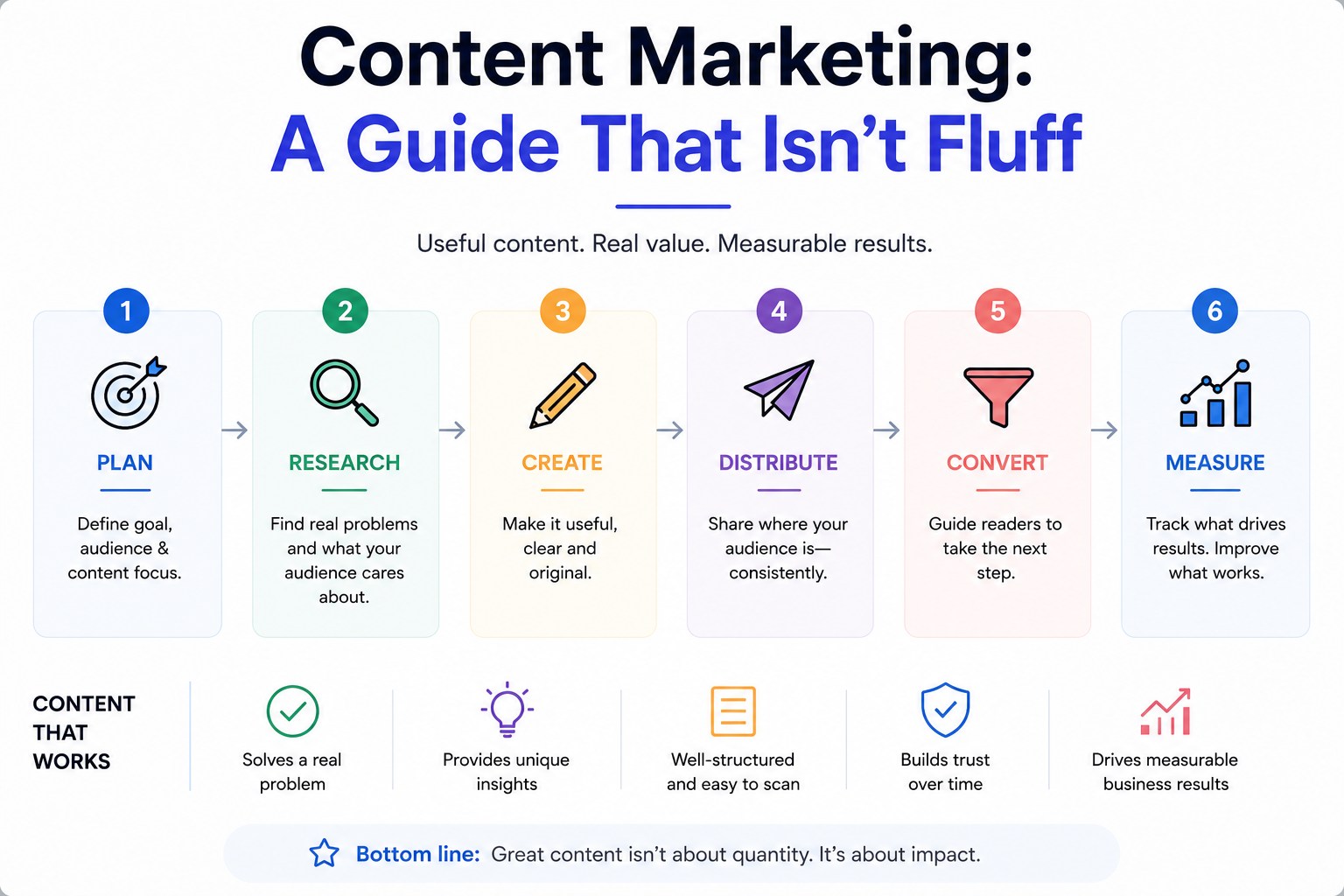
You have read the fluffy content marketing guides. Create valuable content, be consistent, tell stories, and other advice that sounds fine and helps nobody. This is the version I wish those articles were: what content marketing actually is, what makes it work, and how to tell if yours is paying off.
Content marketing is the practice of creating and sharing useful content to attract and keep a specific audience, so that some of them eventually buy from you. It works when the content genuinely helps a defined person, gets distributed where they already are, and is measured against business goals rather than vanity metrics.
What content marketing really is
Content marketing earns attention by being useful instead of buying it with ads. Instead of interrupting people, you publish the guide, tool or answer they were already searching for, and you build trust across many small helpful moments until buying from you feels obvious. The trap most teams fall into is confusing activity with strategy: publishing constantly without a clear reader, purpose or path to revenue. Volume is not the goal, usefulness aimed at a buyer is.
Start with strategy, not a content calendar
The work that separates results from noise happens before you write a word. Define one clear audience, the problems they have, and the questions they ask on the way to solving them. Then decide what you want a reader to do next. A calendar full of topics with no strategy behind it produces traffic that never converts. If you sell software or serve a niche, our SaaS SEO playbook shows how to tie content to a real funnel rather than a posting schedule.
Create content people actually use
Useful beats clever every time, so build content around what your audience is trying to get done. Answer real questions completely, show your work, and cut the throat-clearing introductions nobody reads. Search remains the engine that keeps good content working for years, which is why most content strategy runs through search intent. Learn to find those questions with our guide on keyword research, and structure each piece to rank and be cited using the post that ranks framework.
Organize content so it compounds
One-off posts fade, but connected content compounds. Group your work into topic clusters, with a broad pillar page linking to focused articles that each answer a specific question, so both readers and search engines see you as a genuine authority on the subject. This structure is how a blog stops being a pile of posts and becomes a resource. Our guide to topic clusters and pillar pages lays out the model, and it is the single biggest upgrade most content programs are missing.
Distribution is half the job
Publishing is not distribution, and the teams who forget that wonder why great content gets no traffic. For every hour writing, plan real time to get the piece in front of people: search visibility first, since it delivers for years, plus email, relevant communities and the occasional partnership. Search is the highest-return channel because intent is built in, so the technical and on-page work behind search visibility is part of distribution, not a separate chore.
Measure what matters, ignore what does not
Most content dashboards track the wrong things, so pick metrics that connect to money. Pageviews and time on page feel good but tell you little. Track which content assists sign-ups and sales, which questions bring qualified visitors, and how your content contributes to pipeline over months. Our guide to measuring SEO ROI covers how to connect content to revenue instead of applause, which is the difference between a program that survives budget season and one that does not.
Keep old content alive
Content marketing is not only about publishing new things. Your best returns often come from improving pages you already have, because they already carry some authority and history. Update the facts, sharpen the answer, add what you have learned, and republish. A steady refresh habit usually beats chasing more new posts. Confirm each page is search and answer ready by running it through our free SEO and GEO tools before you push it live again.
The short version
Pick one audience, answer their real questions better than anyone, structure it into clusters, distribute through search first, and measure against revenue. That is content marketing without the fluff. Start by auditing what you already have with a free site audit, fix the pages closest to a sale, then build from there. Consistency helps, but only after the strategy underneath it is sound. And resist the urge to copy a competitor's content plan wholesale, because you rarely see their data or their goals. What looks like a winning blog from the outside might be losing money on the inside. Build your own plan around your own audience and your own numbers, and you will outlast the teams still chasing whatever went viral last week.
Frequently asked questions
How is content marketing different from just blogging?
Blogging is publishing posts, while content marketing is publishing with a strategy: a defined audience, a purpose for each piece, and a path to revenue. A blog with no reader in mind produces traffic that never converts. Content marketing uses formats like blogs, tools and guides deliberately, aimed at attracting and keeping the specific people who might eventually buy from you.
How long does content marketing take to work?
Usually several months before results compound, because search visibility and trust build gradually. Individual pieces can gain traction faster if they answer an underserved question, but the program-level payoff comes from a body of connected content maturing over quarters. This is why measuring against revenue over months, rather than judging single posts by early pageviews, keeps expectations honest.
What should I measure to know if it is working?
Track metrics tied to money: which content assists sign-ups and sales, which questions bring qualified visitors, and how content contributes to pipeline over time. Pageviews and time on page feel reassuring but rarely predict revenue. Connecting content to business outcomes, rather than to applause metrics, is what protects a content program when budgets get scrutinized.
Should I focus on new content or updating old content?
Do both, but do not neglect updates. Existing pages already carry authority and history, so refreshing their facts, sharpening the answer and republishing often returns more than another new post. A steady refresh habit keeps your best pages competitive as search results and AI answers evolve, and it usually beats chasing volume for its own sake.
Do I need a big team to do content marketing?
No. A small team or even one person can succeed by narrowing focus: one clear audience, a tight set of questions, and quality over volume. Trying to publish everywhere at once is what burns out small teams. Strategy, useful content and search distribution matter far more than headcount, and a focused program beats a scattered large one.
Want this done for your site?
Run a free audit and see exactly what to fix for Google and AI search.