SEO vs AEO vs GEO: what's the difference?
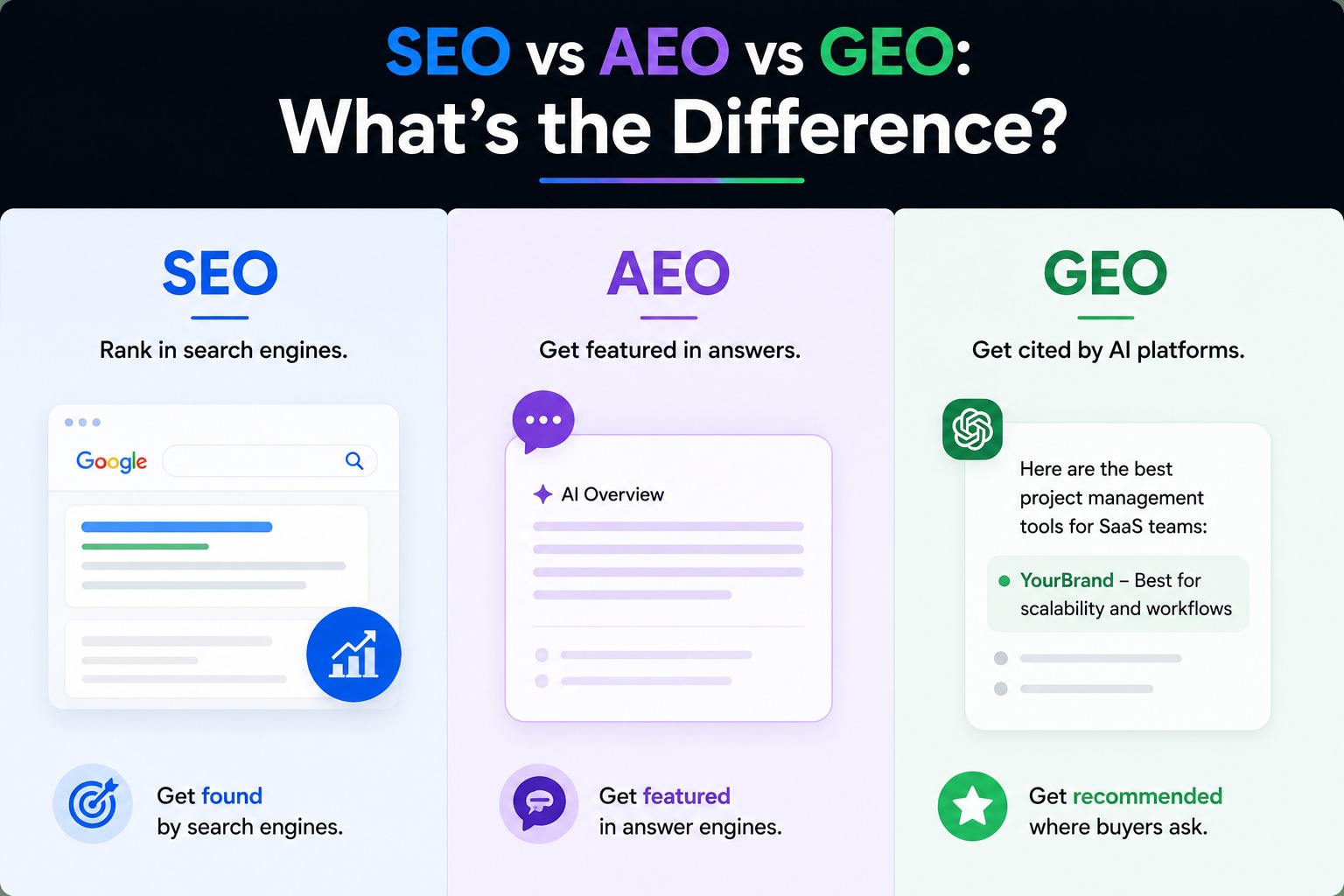
Three acronyms, endless confusion. Your agency mentions AEO, a vendor pitches GEO, and you are left wondering whether these are real disciplines or repackaged SEO with a new invoice attached. Let me settle it in plain terms, because the difference is real and it changes what you work on.
SEO gets your pages ranked in search results, AEO gets your content chosen as the direct answer in featured snippets and voice results, and GEO gets your brand cited inside AI-generated answers from tools like ChatGPT and Perplexity. Same foundation, three different finish lines, and most sites now need all three.
What SEO does
SEO, search engine optimization, is the work of ranking your pages in a list of results. It covers keyword targeting, on-page content, site structure, page speed and links from other sites. The goal is a click: someone searches, sees your listing, and visits. This is the oldest and still the largest channel, and it remains the base layer the other two build on. If you are new to it, start with our plain-English guide to what SEO is, then tighten the mechanics from there.
What AEO does
AEO, answer engine optimization, aims to have your content chosen as the single direct answer rather than one link among ten. That means featured snippets, the People Also Ask box, and voice assistant responses. The work shifts toward answering a specific question in the first sentence, using clean structure and schema so a machine can lift your answer confidently. It is still search, but the prize is the answer slot, not the tenth position. Our explainer on what AEO is goes deeper, and winning featured snippets is the tactical companion.
What GEO does
GEO, generative engine optimization, aims to get your brand named inside answers written by AI tools. When someone asks ChatGPT, Gemini or Perplexity a question and the model writes a paragraph citing sources, GEO is the work that puts you among those sources. It leans on clear answer content, third-party authority and being quotable, because the model is summarizing rather than ranking. The full method sits in our guide on getting cited by ChatGPT, Gemini and Perplexity.
A quick example to ground it
Say you sell project management software and someone wants help choosing a tool. In SEO terms, you want your comparison page ranking when they search best project management software. In AEO terms, you want your one-sentence definition of the category winning the featured snippet above those results. In GEO terms, you want ChatGPT to name your product when the same person asks it for a shortlist instead of searching at all. Three surfaces, one buyer, one underlying page doing the work if you built it well.
How they actually relate
Here is the part the buzzwords hide: these are layers, not rivals. Good SEO content, structured for a direct answer, from a site with real authority, tends to do well in all three at once. You rarely optimize purely for one. A well-built explainer can rank in Google, win a snippet, and get quoted by Perplexity from the same page. So the SEO vs AEO vs GEO question is less about choosing and more about making sure your best content is ready for every surface where your audience asks questions.
Where they genuinely differ in practice
The differences show up in emphasis. SEO cares a lot about links and rankings. AEO cares about precise question-answer formatting and schema. GEO cares about third-party citations and being summarizable, and it is harder to measure because there is no ranking report, only whether the model names you. That measurement gap is why GEO feels newer and murkier, even though the underlying content work overlaps with the other two.
Which one should you focus on
Focus on SEO first if your fundamentals are shaky, because AEO and GEO both stand on it. A page that cannot be crawled or trusted will not win an answer box or an AI citation either. Once the base is solid, add answer-shaped structure for AEO and third-party authority for GEO on the pages that matter most to buyers. If you run software or sell to researchers, our note on GEO for B2B SaaS shows how the priority shifts toward being cited.
Turning this into a plan
Stop treating these as three budgets and treat them as one checklist per page: can it rank, can it win an answer, can it be cited. Run your key pages through our free SEO and GEO tools, work down the AEO and GEO checklist, and you will cover all three surfaces without paying three times for the same work. The finish lines differ, but the road to each starts on the same page. Get that page right once, and it earns you rankings, answer boxes and AI citations for as long as the content stays true.
Frequently asked questions
Are AEO and GEO just SEO with new names?
They overlap heavily but are not identical. All three share fundamentals like clear content and authority. SEO targets rankings, AEO targets the direct answer slot in snippets and voice, and GEO targets citations inside AI-written answers. The names are new because the answer surfaces are new, but the underlying content work is closely related rather than a rebrand for extra invoices.
Which should a small business prioritize first?
Start with SEO, because AEO and GEO both depend on it. A page that cannot be crawled, trusted or understood will not win an answer box or an AI citation either. Once your technical foundation and content quality are solid, layer answer-shaped formatting for AEO and third-party authority for GEO onto the pages that matter most to your buyers.
Can one page do well in SEO, AEO and GEO at once?
Yes, and that is the goal. A well-structured explainer from an authoritative site can rank in Google, win a featured snippet, and get quoted by Perplexity from the same content. That is why you rarely optimize purely for one discipline. Build each key page to answer clearly, structure it well, and back it with authority, and it competes on all three surfaces.
Why is GEO harder to measure than SEO?
Because there is no ranking report for AI answers. With SEO you can see positions and clicks, and with AEO you can spot snippet wins. GEO only shows whether a model names you when someone asks, which you have to check by running prompts yourself and watching for referral traffic from AI domains. The measurement gap is what makes GEO feel newer.
Do I need separate agencies or budgets for each?
No. Treat them as one checklist per page rather than three budgets: can it rank, can it win an answer, and can it be cited. Most of the work, clear answers, clean structure, real authority, serves all three at once. Splitting into three teams usually means paying repeatedly for overlapping work on the same pages.
Want this done for your site?
Run a free audit and see exactly what to fix for Google and AI search.