Domain authority: what it is and isn't
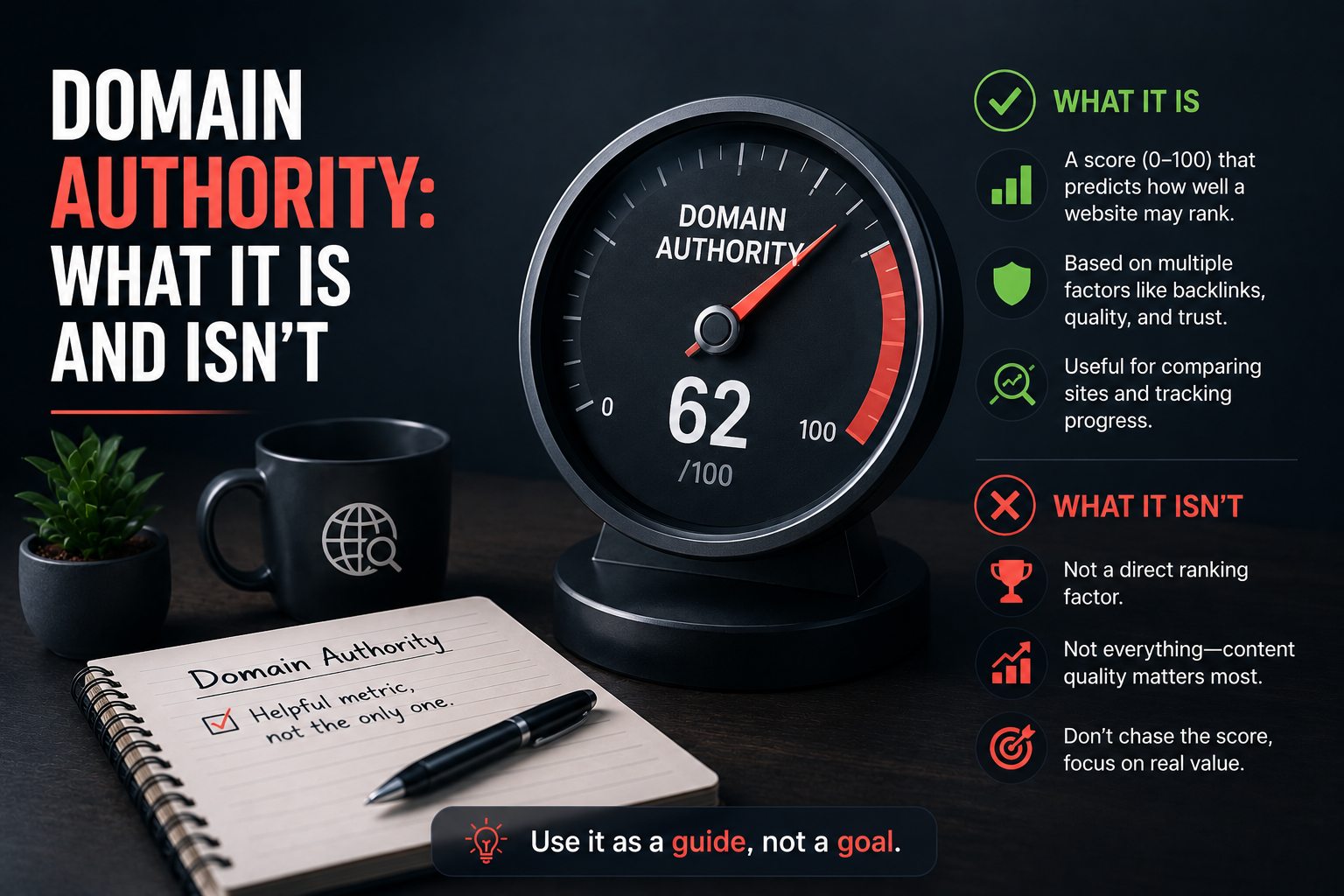
Domain authority is one of the most misunderstood numbers in SEO. People treat it as a grade Google hands out, chase it like a high score, and judge every link by it. None of that is quite right, and believing it can lead you to waste effort on the wrong things. So let me be clear about what the number is and what it is not.
Domain authority is a third-party score, created by SEO tools, that predicts how well a site might rank based mostly on its link profile. It is not a Google ranking factor, and Google does not use it. Treat it as a rough comparison tool, useful for judging link opportunities, never as the goal itself.
What domain authority actually measures
Domain authority measures a tool's estimate of a site's ranking strength, built largely from the quantity and quality of links pointing to it. Different tools have their own versions with different names and scales, so the numbers do not match across them. The score is a prediction, not a measurement of anything Google reports. Our off-page SEO guide explains the real signals these tools try to approximate.
Why it is not a Google ranking factor
It is not a ranking factor because Google does not calculate or use it. Google has said plainly that there is no single site authority score driving rankings. What Google does weigh is relevance, content quality, and trust signals, which link-based scores only estimate from the outside. When someone tells you to raise your DA to rank, they are describing a proxy, not the thing itself.
When the score is actually useful
The score is useful as a quick way to compare sites during outreach. If you are choosing between two link opportunities and one sits on a far stronger site, the number gives you a fast read on relative strength. It also helps you track your own profile over time. Just pair it with judgment, since a lower-scored site that is highly relevant to your topic often passes more real value than a high-scored site that has nothing to do with you. This matters when you run the tactics in our backlink guide.
How the score can mislead you
The score misleads you when you treat it as a target. Chasing a higher number tempts people toward buying links or pursuing high-scored but irrelevant sites, both of which can hurt more than help. It also updates on the tool's schedule, not Google's, so it can lag behind reality. And because it leans on links, it can undervalue a newer site producing genuinely excellent, relevant work. If you want links that count, focus on earning real coverage rather than moving a dial.
What to focus on instead
Focus on relevance, quality, and earning links you could defend to a client. A single link from a respected, on-topic site does more for you than a jump in any third-party score. Build pages worth citing, run steady outreach, and let the number rise as a side effect. For the full approach, our link building guide lays out tactics that improve your standing without gaming a metric.
How to use it in practice
Use domain authority as one input among several, never the deciding one. When you weigh a link opportunity, check relevance first, then the site's real traffic and quality, then use the score as a tiebreaker. When you track your own progress, watch rankings and traffic as the true measures and let the score be a rough companion. A free SEO audit gives you those real numbers, and the free SEO tools help you compare link targets without overpaying for a suite.
Where the confusion comes from
Much of the confusion traces back to the name. Calling it authority makes it sound official, as if Google stamped a grade on your site. Vendors lean into that impression because a single number is easy to sell and easy to track. There is nothing wrong with the tools themselves, and their scores are built by capable people doing real work. The problem is only in how the number gets used. When an agency promises to raise your score, ask what they will actually do to earn it, because the honest answer is the same work that improves rankings: relevant content and real links. If the answer involves buying links or hitting a target for its own sake, that is your signal to be careful. Understand the number, use it lightly, and you avoid the trap that catches people who mistake the map for the territory.
The number is a convenient shorthand, and shorthand is fine as long as you remember it is not the real thing. Judge sites by relevance and quality first, use the score to break ties, and you will make better link decisions than anyone treating it as a grade from Google.
Frequently asked questions
Is domain authority a Google ranking factor?
No. Domain authority is a third-party score made by SEO tools, and Google does not calculate or use it. Google has said there is no single site authority score behind rankings. What Google weighs is relevance, content quality, and trust, which these scores only estimate from a site's link profile.
What is a good domain authority score?
There is no universal good number, because the scale is relative and differs between tools. What matters is how your site compares to competitors for the searches you care about. Rather than chasing a threshold, judge link opportunities by relevance and quality first, and treat the score as a rough comparison rather than a goal.
How do I increase domain authority?
You raise it as a side effect of earning relevant, quality links, not by targeting the number directly. Build pages worth citing, run steady outreach, and gain links from respected on-topic sites. Chasing the score itself tempts people into buying links or pursuing irrelevant sites, both of which can do more harm than good.
Should I reject links from low-authority sites?
Not automatically. A lower-scored site that is highly relevant to your topic often passes more real value than a high-scored site with no connection to you. Check relevance and genuine quality first. Use the authority score only as a tiebreaker when two opportunities are otherwise similar, never as the first filter.
Why does my domain authority change without new links?
Because the score updates on the tool's schedule and recalculates across its whole index. When the tool re-crawls the web or adjusts its model, your number can shift even if your links have not. This is one reason to treat it as a rough proxy and watch real rankings and traffic as the true measures.
Want this done for your site?
Run a free audit and see exactly what to fix for Google and AI search.