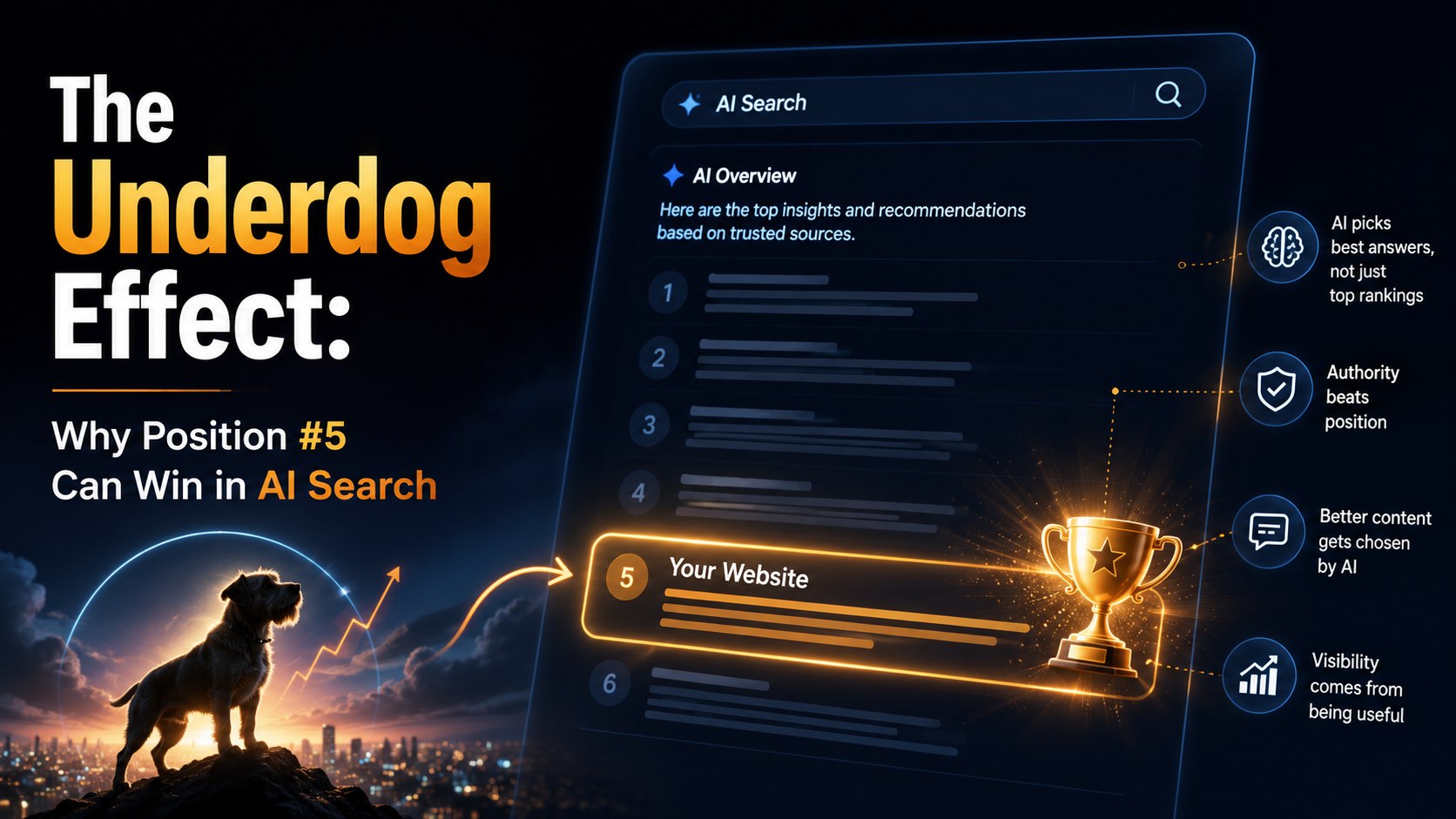
The Underdog Effect: Why Position #5 Can Win in AI Search
Classic SEO is brutal to the little guy. The top result takes most of the clicks, and unseating an entrenched giant can take years of link-building. AI search does not work that way, and that is genuinely good news if you are not the biggest name in your category.
What is the underdog effect in AI search?
The underdog effect is the finding that lower-ranked pages gain the most AI visibility when they apply claim-level GEO tactics. In the Princeton GEO study, pages ranking around position five saw up to a 115% visibility boost from tactics like adding citations, while top-ranked pages barely moved. AI rewards the content, not just the rank.
Why AI levels the field
Traditional ranking leans heavily on domain authority and backlinks, which pile up for established brands. AI citation works at the claim level: the engine looks for a specific, well-stated fact it can lift, wherever it sits in the results. A precise page ranked fifth can offer a cleaner quote than a vague page ranked first, so the engine takes the fifth.
The catch: you still need to be in the pool
This is not a free pass. To be considered by an engine like Google AI Overviews, you generally need to rank somewhere on the page. The underdog effect helps pages that already rank respectably, around positions three to eight, punch above their weight. It does not rescue a page sitting on result page five of Google.
How to use the underdog effect
Find your pages that rank in the middle of page one and are not getting cited by AI. Rewrite them for extraction: a clear answer up front, vague claims turned into sourced numbers, an FAQ with schema. You are not fighting for the top Google spot; you are making a decent-ranking page the most quotable one on the topic.
Key takeaways
- Lower-ranked pages gained the most AI visibility from claim-level tactics in the Princeton study.
- AI cites the cleanest fact regardless of rank, so precision can beat position.
- You still need to rank on page one to be in the candidate pool.
- Target your middle-of-page-one pages and rewrite them to be the most quotable.
See which of your ranking pages AI overlooks with the Creative Nexus Citation Engine.
Frequently asked questions
What is the underdog effect in GEO?
It is the finding that lower-ranked pages gain the most AI visibility when they apply claim-level tactics. The Princeton study saw position-5 pages boosted up to 115%, while top pages barely changed.
Where does the 115% figure come from?
From the Princeton and Georgia Tech GEO study presented at KDD 2024, which measured how much different tactics raised AI citation rates across pages at different search positions.
Why does AI help lower-ranked pages?
Because AI cites specific, well-stated facts rather than whole authoritative pages. A precise page ranked fifth can offer a cleaner quote than a vague page ranked first, so the engine chooses it.
Does this mean I can ignore rankings?
No. To be considered by engines like Google AI Overviews you generally need to rank on page one. The underdog effect helps decent-ranking pages punch up; it does not rescue pages buried deep in results.
Which pages should I optimise first?
Pages that rank in the middle of page one, roughly positions three to eight, and are not being cited by AI. They are close enough to be considered and have the most room to gain.
What tactics create the underdog boost?
Claim-level changes: adding citations to credible sources, adding statistics with a source and year, quoting named experts, and leading each section with a clear answer. Citing sources was especially powerful in the study.
Can a brand-new page benefit from this?
Only after it ranks. A page with no ranking is not in the pool AI draws from, so build baseline SEO first, then apply the claim-level tactics to gain citations.
Does the underdog effect apply to all AI engines?
The principle of rewarding extractable claims over raw authority appears across engines, though the exact behaviour varies. Engines that retrieve live and re-rank, like Perplexity and Google AI Overviews, reflect it clearly.
How do I know if AI ignores my ranking pages?
Use a citation tracker that queries AI engines on your topics and records whether your brand appears. Comparing that with your rankings shows which well-ranked pages are being skipped.
Is this a lasting advantage or a loophole?
It reflects how AI values content, so it is durable as long as you keep the substance high. It rewards genuinely clearer, better-sourced pages, which stays valuable even as engines evolve.
Want this done for your site?
Run a free audit and see exactly what to fix for Google and AI search.