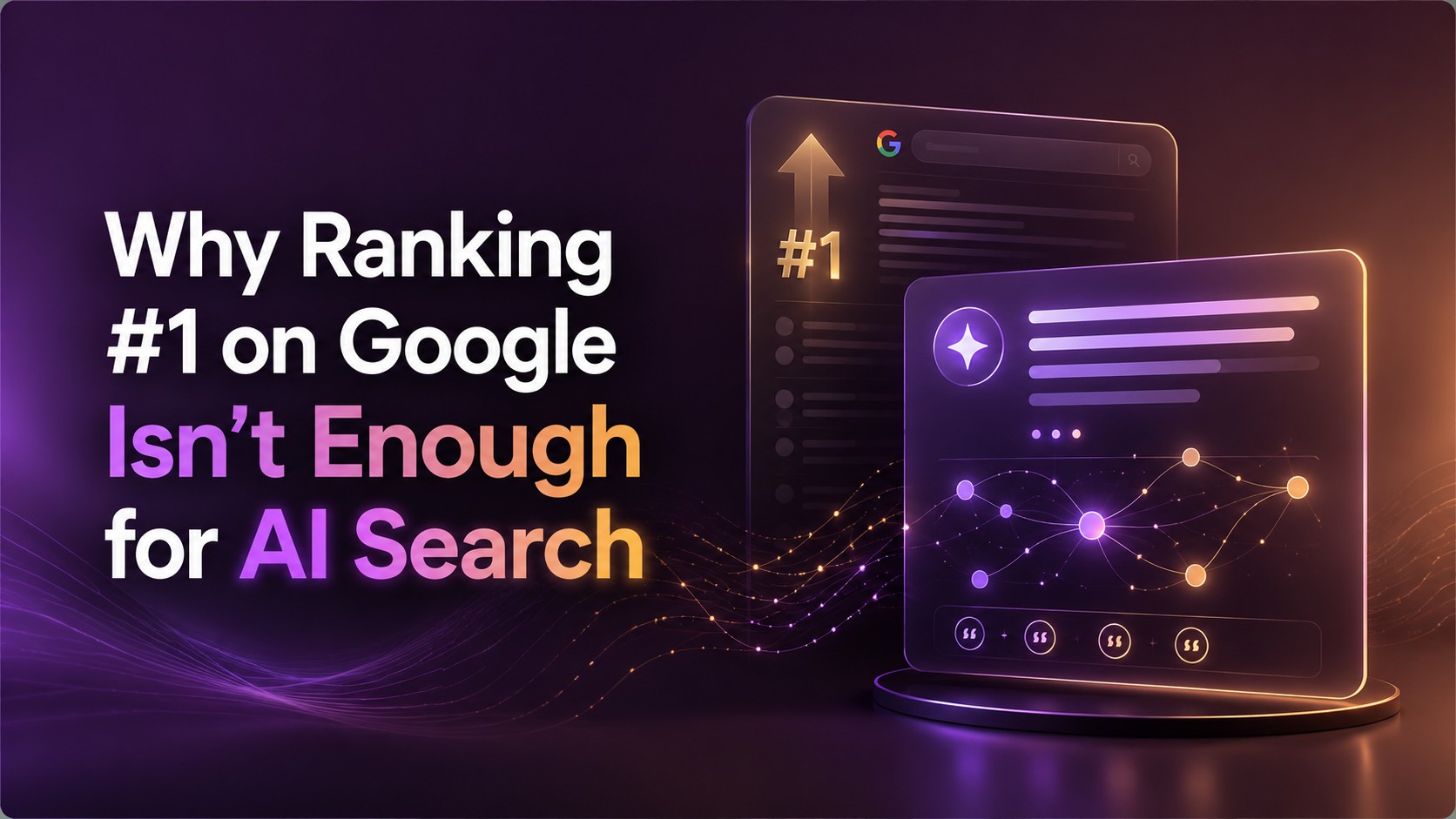
Why Ranking #1 on Google Isn't Enough for AI Search
You spent months earning the number-one spot for your best keyword. Then you asked an AI the same question and your brand was nowhere in the answer. That gap is real, and it is catching a lot of strong sites off guard.
Does ranking #1 on Google mean AI will cite me?
Not reliably. Industry analyses in 2025 found that only around half of the pages ranking first on Google are actually cited by AI answer engines. A top ranking gets you into the pool an engine draws from, but it does not decide whether your page is the one it quotes.
Why the two diverge
Google ranking rewards relevance, authority and links across a whole page. AI citation works at the claim level: the engine looks for a specific, cleanly stated fact it can lift into an answer. A page can be authoritative overall yet bury its facts in prose that is hard to extract, so it ranks well and gets cited rarely.
The upside for smaller sites
The same gap that costs a big brand its citation gives a smaller one an opening. Research from Princeton found that pages ranking lower, around position five, gained the most AI visibility when they applied claim-level tactics. If a giant's top page is vague, a precise page beneath it can be the one an AI quotes.
How to make a top page citable
Take your best-ranking pages and rewrite for extraction. Put a clear answer in the first sentence of each section. Turn vague claims into numbers with a source and a year. Add an FAQ with schema so each answer is a ready-made quote. You keep the ranking and gain the citation.
Key takeaways
- Only about half of Google's top pages get cited by AI, so ranking is necessary but not sufficient.
- AI cites at the claim level, so a well-ranked page with buried facts still loses.
- Lower-ranked pages gained the most from claim-level tactics in the Princeton study.
- Rewrite top pages for extraction to keep the rank and win the citation.
Find out which of your ranking pages AI ignores with the Creative Nexus Citation Engine.
Frequently asked questions
Does ranking first on Google guarantee AI citations?
No. Analyses in 2025 found only about half of pages ranking first on Google are cited by AI engines. Ranking gets you into consideration, but not automatically into the answer.
Why doesn't my top-ranked page get cited by AI?
AI cites specific, cleanly stated facts rather than whole pages. If your best page is authoritative but buries its facts in dense prose, it can rank well yet be hard for an engine to quote.
What is the overlap between Google rankings and AI citations?
Roughly half, according to 2025 industry data. That means a large share of top Google results are absent from AI answers, and many cited pages are not the top-ranked ones.
Can a lower-ranked page get cited over a higher one?
Yes. The Princeton study found lower-ranked pages, around position five, gained the most AI visibility from claim-level tactics. A precise page can be quoted over a vaguer one that ranks above it.
How do I make a ranking page citable?
Rewrite it for extraction: lead each section with a clear answer, turn vague claims into sourced numbers, and add an FAQ with schema. You keep the ranking while making the content easy to quote.
Does this mean SEO is useless for AI?
No. Ranking still puts you in the pool that AI draws from, especially for Google AI Overviews. SEO is the entry ticket; claim-level GEO tactics decide whether you are the one cited.
How do I know if AI cites my pages?
Use a citation tracker that queries the major engines on your topics and records whether your brand appears. Comparing that to your rankings shows exactly where the gap is.
Why does AI care about claims, not pages?
Because it synthesizes an answer sentence by sentence and needs facts it can lift and attribute. A claim with a number and a source is a ready unit; a whole authoritative page is harder to quote precisely.
Should I rewrite all my pages at once?
Start with your highest-value ranking pages, since they already have authority and traffic. Rewriting those for extraction gives the fastest return before you work down the list.
Is the ranking-to-citation gap growing?
As more search shifts to AI answers, the gap matters more, because a ranking that earns no citation reaches fewer people. Closing it on your key pages protects visibility as behaviour shifts.
Want this done for your site?
Run a free audit and see exactly what to fix for Google and AI search.