How RAG Works: Why AI Quotes One Page Over Another
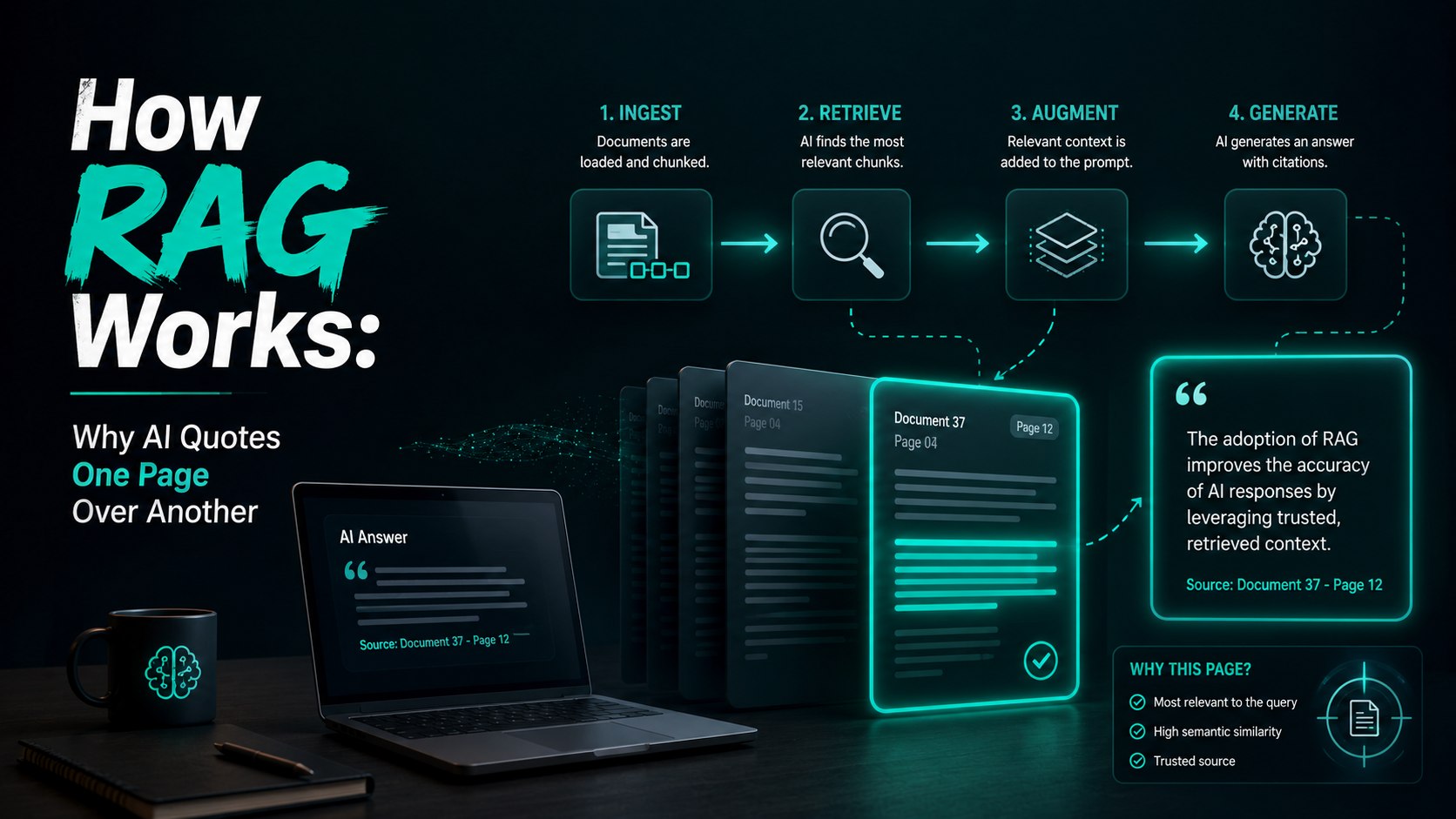
When Perplexity answers a question, it isn't reciting something it memorised. It goes and reads the web in that moment, then decides which pages to quote. The name for that process is Retrieval-Augmented Generation, and it runs in three stages that each decide whether you get cited.
What is retrieval-augmented generation?
RAG is the method most AI answer engines use to give current, sourced answers. Rather than rely only on what a model learned in training, it retrieves live documents, filters them, and generates an answer from the survivors. That is how an AI can cite a page published yesterday, and why your on-page work still matters in the AI era.
Stage one: retrieval
The engine takes the question and searches an index or crawls the live web for pages that match the meaning, not just the keywords. If your page isn't crawlable, or your key facts only load after JavaScript, you can fail here before anything else happens. Getting retrieved is the price of entry.
Stage two: re-ranking
Retrieval casts a wide net, so a middle layer sorts the catch. It scores each candidate for quality and usefulness and throws out the noisy, thin or messy ones. Clean structure, clear claims and readable prose survive this filter. Padding and tangled writing get cut here, which is why word count alone never helped.
Stage three: generation
Now the model reads what's left and writes the answer, choosing which sources to credit. It favours pages it can quote cleanly: a self-contained sentence with a number and a source is easy to lift; a claim buried in a long paragraph is easy to skip. This is the stage the GEO tactics target directly.
What RAG changes about optimisation
Traditional search ranked pages mostly on popularity and backlinks. RAG cares less about how many sites link to you and more about how easily it can extract a fact from your page. That shift is good news for smaller sites: a precise, well-sourced page can be quoted over a bigger but vaguer one.
Key takeaways
- RAG runs in three stages: retrieval, re-ranking, generation. You must clear all three.
- Re-ranking drops noisy, padded pages, so clean structure earns its keep.
- Generation favours self-contained, quotable sentences with numbers and sources.
- RAG rewards extractable facts over raw link popularity, which helps precise small sites.
Check whether AI engines can retrieve and read your pages with a Creative Nexus audit.
Frequently asked questions
What is RAG in AI search?
Retrieval-Augmented Generation is the method AI answer engines use to give current, sourced answers. They retrieve live documents, filter them, and generate a response from the best ones, rather than relying only on training data.
Why do AI engines use RAG?
To stay accurate and up to date. Training data is frozen at a point in time, so retrieving live pages lets an engine answer about recent events and cite specific sources, which reduces made-up answers.
What are the three stages of RAG?
Retrieval, where the engine finds candidate pages; re-ranking, where it filters them for quality; and generation, where the model writes an answer and credits the sources it trusts most.
What can stop my page being retrieved?
Blocked crawlers, content that only loads after heavy JavaScript, or thin pages with no clear match to the query. If you fail retrieval, nothing later in the process can help you.
What survives the re-ranking stage?
Pages with clean structure, clear claims and readable prose. The filter discards noisy, padded or tangled content, which is why adding word count without adding facts does not help.
How does the generation stage pick sources?
It favours content it can quote cleanly. A self-contained sentence with a number and a source is easy to lift; a claim buried in a long paragraph is easy to skip. Structure and specificity win here.
Does RAG use backlinks?
Less than traditional search does. RAG weighs how easily it can extract a fact from your page over how many sites link to you, which is why a precise smaller page can be cited over a larger vague one.
How is RAG different from normal Google search?
Normal search returns a ranked list of links for you to read. RAG reads the pages itself, then writes a single synthesized answer and cites a few sources, changing the goal from ranking to being quotable.
Can I optimise for RAG?
Yes. Make pages crawlable for retrieval, keep structure clean for re-ranking, and write self-contained, sourced claims for generation. Each stage maps to a concrete thing you can improve.
Which engines use RAG?
Perplexity, Google AI Overviews and the search modes of ChatGPT and Gemini all use retrieval-based approaches. Pure training-only responses are becoming rarer as engines add live retrieval for freshness.
Want this done for your site?
Run a free audit and see exactly what to fix for Google and AI search.