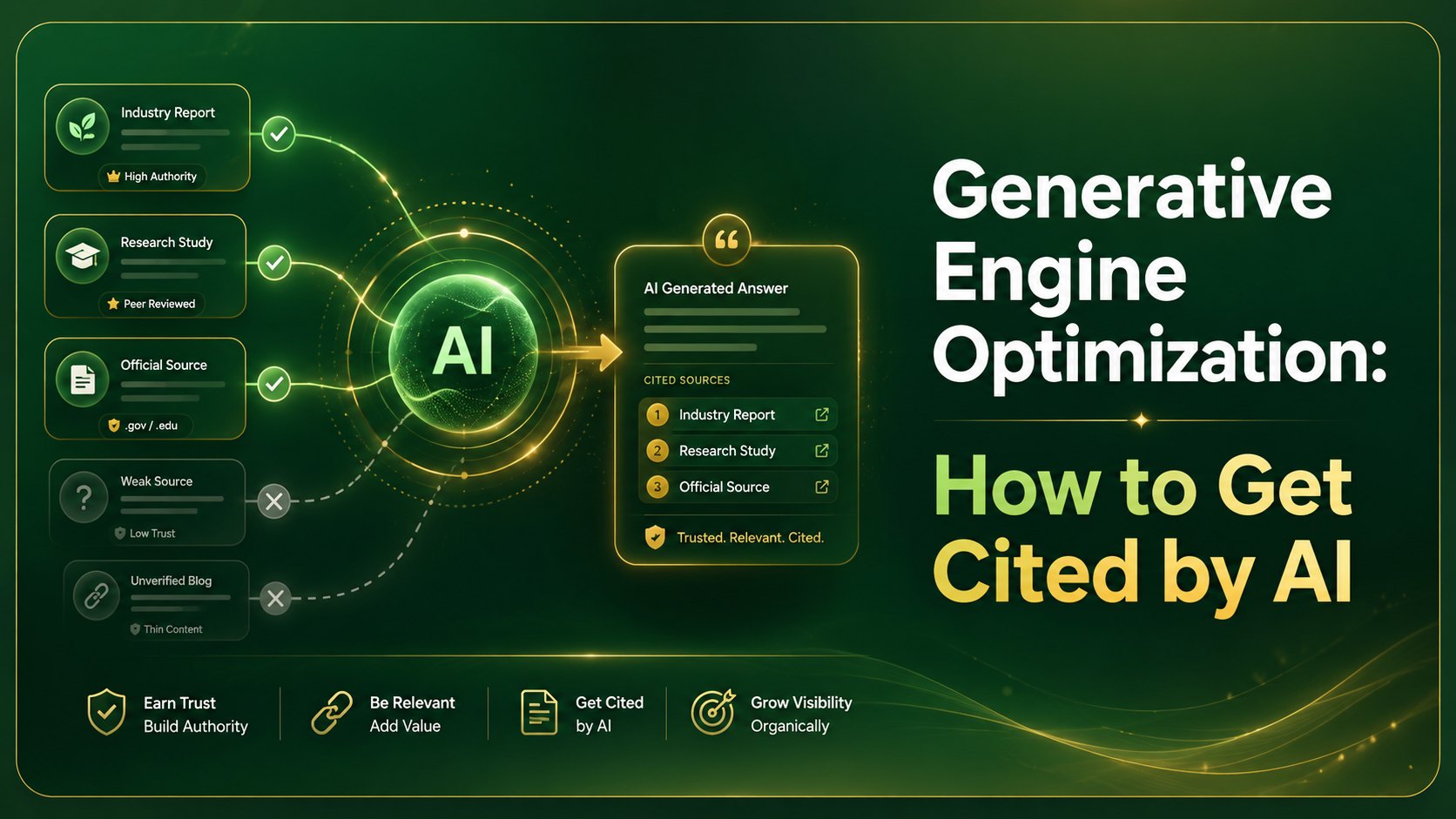
Generative Engine Optimization: How to Get Cited by AI
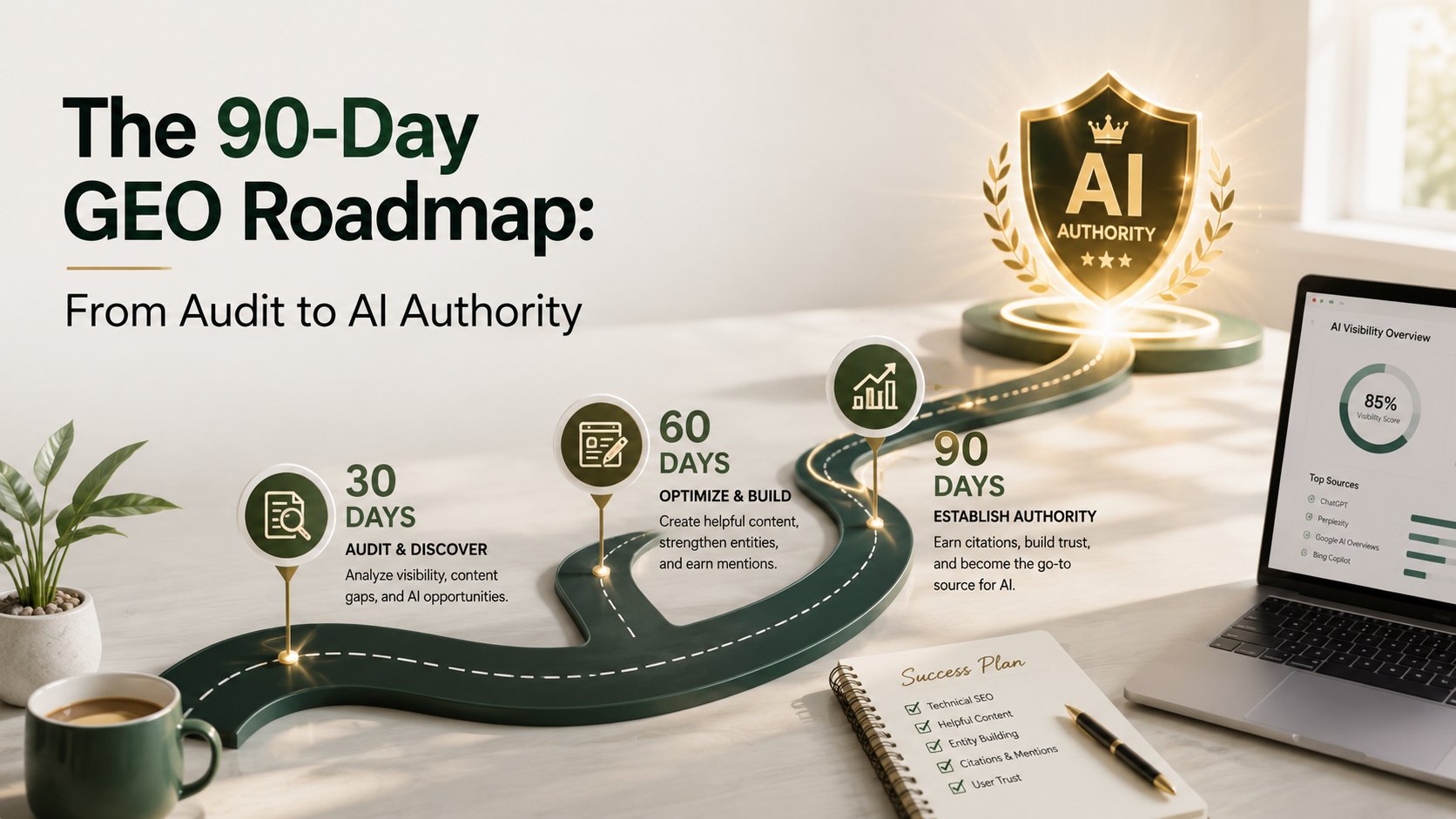
Say your guide ranks first on Google for its topic. You ask ChatGPT the same question and it recommends a competitor instead. That is happening across the web right now, and it is a different problem from ranking.
Generative Engine Optimization, or GEO, is the work of getting your brand quoted inside AI answers rather than listed as a link nobody clicks. The engines in question are ChatGPT, Perplexity, Gemini and Google AI Overviews. They read the web, decide what to trust, and write a single answer. Your job is to be the source they trust.
What is generative engine optimization?
GEO structures your content so AI answer engines cite and recommend your brand. Classic SEO chases a ranking position. GEO chases the reference rate: how often an AI names you when someone asks about your category. The visitors it sends have already done their research inside the chat, so they arrive ready to buy rather than ready to browse.
SEO, AEO and GEO side by side
These three are rungs on one ladder. You rank first, get cited second, get recommended third.
| Factor | SEO | AEO | GEO |
|---|---|---|---|
| Goal | Rank in the blue links | Win the featured snippet | Become the recommended brand |
| Surface | Google, Bing | Snippets, voice assistants | ChatGPT, Perplexity, Gemini |
| You measure | Position and clicks | Snippet wins | Citations and share of voice |
How AI decides who to quote
Answer engines don't recall your page from memory. They fetch it live through a process called Retrieval-Augmented Generation, or RAG. It runs in three stages. First the engine retrieves candidate pages from its index or a fresh crawl. Then a re-ranking layer discards the noisy, low-signal ones. Finally the model reads what survives and writes an answer, citing the sources it trusts.
None of that happens if the crawler can't get in. Plenty of sites block the AI bots with an old anti-scraper rule and never notice. Open the door in robots.txt:
# robots.txt — let the answer engines read you
User-agent: GPTBot
Allow: /

User-agent: ClaudeBot
Allow: /

User-agent: PerplexityBot
Allow: /

User-agent: Google-Extended
Allow: /

Sitemap: https://yourdomain.com/sitemap.xml
Once they can read you, give them a clean briefing with an llms.txt file at your root. It is a Markdown summary of the pages and facts you most want quoted, stripped of the menus and scripts that clutter a normal page.
# llms.txt — https://yourdomain.com/llms.txt
# Your Company — one line on what you do.

## Key pages
- /pricing: Plans from $X/mo
- /product: What it does, in plain language
- /docs: API reference

## Facts worth quoting
- Founded 2021. 12,000 teams. SOC 2 Type II.
- Cuts onboarding time 40% (2025 customer audit).
The tactics that get you cited
Researchers at Princeton and Georgia Tech tested nine ways to win AI citations and published the results at KDD 2024 (Aggarwal et al.). Five held up. They work sentence by sentence, on the claim itself.
- Put a number on it. "Cuts onboarding 40% (2025 audit)" gives the model a fact it can lift. "Saves time" gives it nothing.
- Quote a named expert. Attribution reads as verification, so one real quote can carry more weight than a paragraph of your own copy.
- Cite your sources. Linking the original study signals your page checks its facts. This was the move that helped lower-ranked pages break into answers.
- Keep the prose clean. Choppy writing gets dropped at re-ranking. Read it aloud and fix what makes you stumble.
- Say it plainly. "3× faster (independent benchmark)" beats "could be faster." Hedged language tells the model to look elsewhere.
The study also found what wastes your time: keyword stuffing did nothing and hurt on Perplexity, and padding word count just added noise. AI lifts claims, so more words rarely help.
Answer first, then explain
A model reads top to bottom and can stop once it has enough. Bury your answer in paragraph four and it may never reach it. Lead each section with the conclusion, then support it. That habit has a name from military briefings: Bottom Line Up Front.
Make your answers easy to lift with schema
An FAQ block earns featured snippets and hands AI ready-made question-answer pairs. Mark it up with FAQPage JSON-LD so the structure is unmistakable:
{
 "@context": "https://schema.org",
 "@type": "FAQPage",
 "mainEntity": [{
 "@type": "Question",
 "name": "What is generative engine optimization?",
 "acceptedAnswer": {
 "@type": "Answer",
 "text": "GEO structures content so AI engines cite and recommend your brand."
 }
 }]
}
Key takeaways
- GEO is about being quoted, not just found. The metric is your reference rate.
- Get through all three RAG stages: retrieval, re-ranking, generation.
- Build key claims from numbers, quotes and citations. Say them plainly.
- Keyword stuffing and padding are dead weight.
- Smaller sites gained the most in the study, so precision beats brand size.
Check where you stand with the Creative Nexus Report Card, then let AEO Autopilot ship your llms.txt, schema and answer blocks.
Frequently asked questions
What is generative engine optimization?
GEO structures content so AI answer engines cite and recommend your brand. It targets your reference rate inside ChatGPT, Perplexity, Gemini and Google AI Overviews rather than your position in a list of links.
How is GEO different from SEO?
SEO earns a ranking so a person clicks through. GEO earns a citation so an AI quotes you. SEO gets you crawlable; GEO gets you quotable. Most sites need both working together.
What is AEO and where does it fit?
Answer Engine Optimization is the middle step: winning the featured snippet or voice answer. It sits between ranking and recommendation, and its clean structure feeds GEO because the same formatting helps AI extract you.
Do visitors from AI convert better?
They tend to. Someone who clicks from an AI answer has already researched the topic in the chat, so they arrive with higher intent and ask for demos more often than a cold search visitor. Expect lower volume, higher quality.
How do I get cited by ChatGPT?
ChatGPT favours established authority and cites encyclopedic sources heavily. Keep your brand facts consistent everywhere, earn mentions in reputable publications, and add Organization schema so the model can identify you clearly.
How do I get cited by Perplexity?
Perplexity leans on live community discussion and references Reddit heavily. Take part authentically in the forums where your category is discussed and answer real questions, instead of posting marketing copy.
What is llms.txt?
A Markdown file at your site root that gives AI crawlers a clean summary of your key pages and facts, without the noise of a normal page. Adoption is early, which makes shipping one a low-cost edge.
Does keyword stuffing help with AI search?
No. The Princeton study found it produced no benefit, and Perplexity showed reduced visibility for over-optimized pages. AI extracts factual claims, so specificity works and density does not.
Is GEO only worth it for big brands?
The study found the opposite: lower-ranked pages gained the most from these tactics while top pages barely moved. Precise, well-sourced content can outperform a larger but vaguer competitor.
How do I measure GEO without rankings?
Track how often AI links you, how often you are named without a link, your share of voice against competitors, and how the AI describes you. A citation tracker samples these across engines on a schedule.
Want this done for your site?
Run a free audit and see exactly what to fix for Google and AI search.